When we become a School Librarian we don’t stop being a Teacher, in fact, we take on a larger responsibility: to teach the Essential Literacies that are so important in our global society. As I’ve mentioned before, our students need and deserve short, simple lessons that inculcate these multiple literacies through integration with subject area classroom activities.
Literacy is no longer just knowing how to read and write, so for every class visit to the library we need to integrate at least one Essential Literacy component with the classroom topic of study. In our complex, information-rich, culturally diverse world, students need to understand and be proficient in these Five Essential Literacies:
- Reading and Writing (the original literacy)
- Content-area Literacy (thinking specific to a discipline)
- Information Literacy (the library curriculum)
- Digital Literacy (when and how to use various technologies)
- Media Literacy (published works—encompasses all other literacies)
Let’s address each of these literacies through a separate blog post where I offer suggestions how School Librarians might incorporate that literacy into lessons. With this post I begin with what is still considered the most important literacy in our modern world: reading with the associated ability to write.
WHY READING LITERACY IS IMPORTANT
The Organisation for Economic Co-operation and Development (OECD) evaluates education systems worldwide by testing the skills and knowledge of 15-year-old students in ~70 countries. In their Program for International Student Assessment Report of 2003 they state:
The single most important predictor of academic success is the amount of time students spent reading, and this is a more accurate indicator than economic or social status. Time spent reading was highly correlated to success in math and science. The keys to success lie in teaching students how to read and then have them read as much as they can.
Their 2009 PISA report refines this by stating:
Having a deep understanding of reading strategies, and using those strategies, are even stronger predictors of reading performance than whether students read widely for pleasure.
Clearly the ability to read with discernment is the key to success in school, as well as the key to all other literacies. Our National School Library Standards give this definition, with the focus on the medium/format rather than the process:
Text literacy: the ability to read, write, analyze, and evaluate textual works of literature and nonfiction as well as personal and professional documents.
So, clearly reading and writing literacy are within our bailiwick. So, how might we, as School Librarians, make reading a key objective in our library program?
INTEGRATE READING IN LIBRARY VISITS
From kindergarten through high school, teachers bring students to our libraries to check out books. Those visits need to be more than just a quick in-and-out… grab a book, check it out, return to classroom. What we need to do is help students develop a true appreciation for the value of reading.
Notice I said “appreciation for the value of reading,” not ‘a love of reading’. To love reading is a hobby, just like stamp collecting or building model planes, and we can no more teach a love of reading than we can a love of any other hobby. What we can do is expose students to a wide variety of books on many topics so some will come to love reading, and some who love crafts or sports or whatever will choose books on those topics so they can learn more, and that is the true goal: helping students see that reading brings them the information they need to be successful.
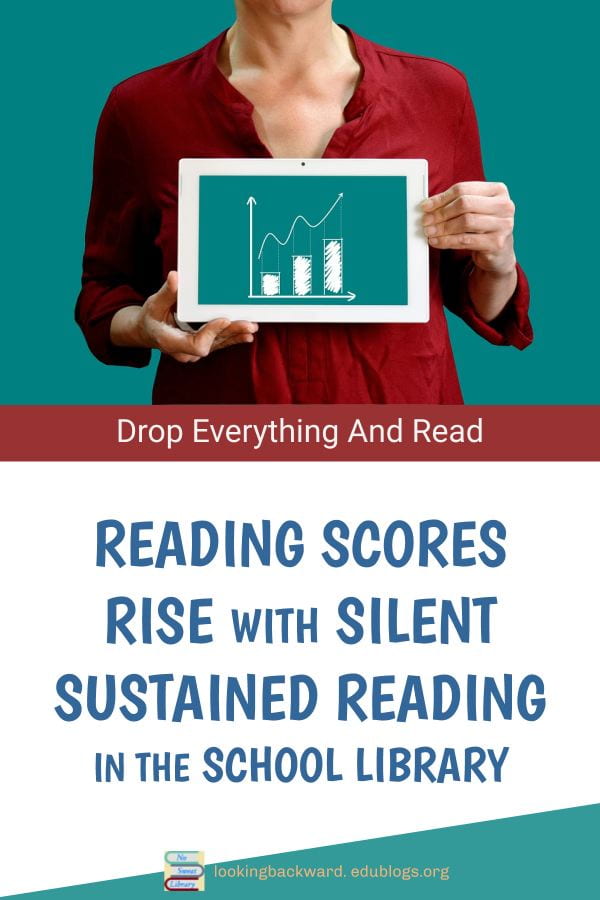
Most importantly, we must give students time to find a book they’ll want to read and then give them more time to begin reading it…to make sure it’s what they want. I begin each school year with a Library Orientation for English Language Arts classes focused entirely on reading. I give students plenty of time to find a book, and then we have silent sustained reading till the end of the period (we called it DEAR Time: Drop Everything And Read).
 Allowing students plenty of time to choose a book and then giving them time to begin reading it allows them to become immersed in the story—they stick with it, they finish it faster, and they want to begin another book. My ELA teachers and I schedule library visits every other week for the entire school year, following the same procedure: short lesson→long book browse→longer silent reading. The biggest benefit to recurring free reading time was that our yearly State Reading Test scores moved steadily upward and remained above state averages for all school populations!
Interestingly, one year we followed a district directive for ELA classes to read 5-10 minutes daily at the start of their class period. Our library visits deteriorated because students became restless during long-term reading. The ELA teachers and I understood why, and when the new semester began, we went right back to DEAR time for the whole period. This convinced us how important it is to give students prolonged reading time.
3 PRACTICES TO PROMOTE READING
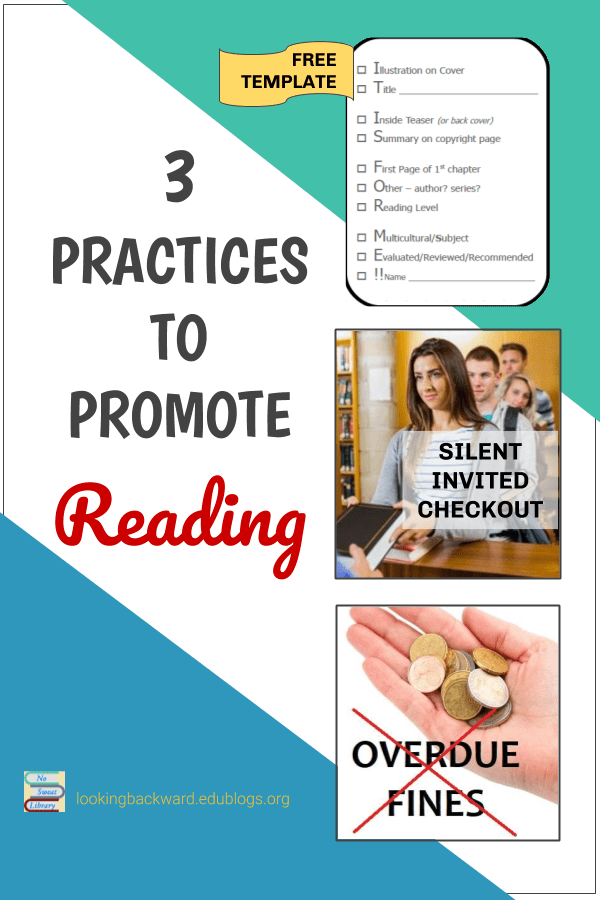
Here are the three practices I implemented that have had the most impact on sustained silent reading and reading achievement:
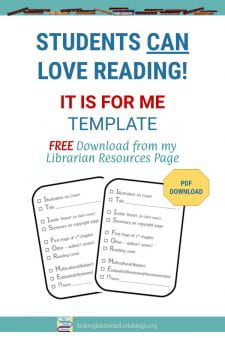
(1) During Book Browse our students use my “IT IS FOR ME” mnemonic checklist to find a book. The 6g ELA teachers require it as an exit ticket for each library visit. The 7g teachers use it at the start of the year, then intermittently after students begin to automatically use it. By 8th grade, returning students are proficient, so teachers focus on establishing the process with newly enrolled students, who quickly adopt it.
(2) During our silent sustained reading we have a quiet invited checkout procedure: I begin on one side of the library and invite students at 2 or 3 tables, depending on numbers, to check out. They line up single file at the circulation desk, continue to read as the line moves up, and after I check out their book they return to their seat. When each group is done, I quietly go over and invite 2 or 3 more tables for checkout. It’s an orderly process with only 8-10 students checking out at a time, and it takes maybe 10 minutes for an entire class, less than 20 minutes for a double class. (If students talk while in line, I send them back to their tables to check out after everyone else; they rarely do it again.)
(3) My 3rd year as School Librarian I decided to eliminate overdue fines. I wrote about this in another blog post: my reasoning is that fines discourage students from reading and collecting fines is time-consuming work for us with little benefit.
We can never, ever, refuse a child the opportunity to read!
BUILD READING LITERACY WITH READING STRATEGIES
While it’s important to promote independent reading, it’s even more important for School Librarians to employ reading comprehension strategies—predicting, making connections, questioning, annotating, inferring, organizing, and summarizing—during library lessons that involve reading.
ORGANIZING
I’ve written about my love for graphic organizers. They organize critical content and students learn to identify text structures by the type of graphic organizer used: classification, compare/contrast, order/sequence, cause/effect, and problem/solution.
For a set of these text structure organizers
and other organizers, take a look at
Cult of Pedagogy’s Graphic Organizer MultiPack.
SUMMARIZING
 Summarizing is the most frequently missed type of question on standardized reading tests. It’s a strategy that students desperately need help with and we School Librarians can do that. I use the prior year’s student magazines and a guided worksheet for an introductory lesson on summarizing informational text. Join my email group to gain access to the worksheet and many other great products!
MAKING CONNECTIONS
 Vocabulary is a common stumbling block for students when learning new content, especially some of our information literacy terminology. I often use graphic organizers to introduce new concepts, especially those that help them make connections between the new words and what they already know. Here are my two favorites:
These are just 3 types of reading strategies we can use to boost students’ comprehension of informational text. I’ve written previously about other ways to promote reading. If you haven’t read them yet, why not do it now and learn more about how you can help students develop Reading Literacy:
- Organize Your School Library’s Fiction Books by Subjects
- How to Support Social Studies Content Reading in the School Library
- A ‘Love’ for Reading & the School Librarian
- Read Alouds & Free Reading in the School Library
- Best Way School Librarians Can Increase Student Reading Achievement
This is the first entry in my series of blog posts on the 5 Essential Literacies for Students. I invite readers to offer comments and suggestions about any or all of these literacies.
Updated 2025.