 We who are School Librarians moved from classroom to library because we wanted to have a greater impact on all students in all subject areas. We are eager to collaborate with teachers—it’s the reason a school needs a certified School Librarian—but we soon discover we’re often the only one in the school who knows that collaboration is supposed to happen.
Alas, too many teachers and administrators view us as someone who just checks out books, mistaking us for paraprofessionals rather than the certified experienced teachers we are. But consider that most of us only learned about teacher-librarian collaboration during our own library coursework, so it’s our responsibility as School Librarians to promote collaborative opportunities with teachers. We can’t expect teachers to come to us; we have to go to them, and we need to show them how their students will benefit from Library Lessons.
FROM SERVICE-BASED TO PRODUCT-BASED THINKING
We lament that teachers don’t make time to collaborate. I believe we need to quit thinking in terms of advocating for, or “marketing,” the school library, or library resources, or even ourselves as a way to promote collaboration. We’ve been doing this for years with little headway. I believe it’s because we offer collaboration as a “service” we can provide them. Now, why would we expect teachers to set aside time to meet with us when we have nothing concrete to offer them? They are already overwhelmed with curriculum, grades, parent communication, IEPs, school meetings, and other duties when they aren’t working with students.
Instead, let’s offer a specific “product” to teachers—an integrated Library Lesson that gives students an Information Literacy skill and the teacher a better learning plan. Further, let’s offer not just any lesson, but an integrated Library Lesson for one of their own “essential” lessons.
Most subject area curricula Standards designate certain “essential” lessons, which typically are “benchmarks” on which students are tested throughout the school year. Many of these integrate technology Standards, but missing are “essential” lessons which integrate the National School Library Standards.
We don’t have to know why these lessons are considered “essential” in order to integrate library skills into them. And we don’t have to do it by ourselves.
USE PROFESSIONAL DEVELOPMENT FOR ESSENTIAL LESSONS
 Librarians in my school district have mapped out library skills at each grade level, building advanced skills from one grade to the next. This K-12 Information Literacy Scope and Sequence, coordinated with National School Library Standards, guides us as we create lessons for any grade, any subject.
We can’t ensure that all kids in X grade learn all the Information Literacy skills they need to prepare them for grade X+1 unless we convince teachers to allocate time for library visits. Thus we’ve begun to use our monthly professional development meetings to make “essential” lessons for various subject areas even more “Essential” by integrating Info-Lit skills.
Since Info-Lit skills are applicable across all content, we first identify each grade’s “essential” lessons for each subject area throughout the school year. Then we determine where we can integrate the introduction, reinforcement, and mastery of grade-specific library skills with the subject-area lessons. For example, if we know kids at X grade level need to master Info-Lit Skill Y, then we can create Essential Lessons to:
- introduce Info-Lit Skill Y into Teacher A’s English Language Arts “essential” lesson,
- reinforce Info-Lit Skill Y through Teacher B’s Social Studies “essential” lesson, and
- help students master Info-Lit Skill Y during Teacher C’s Science “essential” lesson.
This type of scaffolding is familiar to classroom teachers, and they will appreciate how we improve their “essential” lessons to “Essential Lessons” by integrating library and research skills. Rather than teaching a discrete lesson for a random library visit, this collaborative “product” generated by School Librarians ensures that everyone comes out ahead!
MARKET THE “PRODUCT”
“Essential Lessons” can boost our teacher collaborations at every grade level and subject area across our entire school district. As we show these lesson plan “products” to teachers, we are convincing them that our lessons provide value to them and to their students. We also aim to have students produce an authentic assessment product so the teacher will want us to teach another lesson later on, giving us an opportunity to introduce or reinforce another Info-Lit skill through another Essential Lesson.
As we use our professional development to create more Essential Library Lessons, we’re striving to improve student achievement, increase use of the library and its resources, and enhance our visibility in the school.
A PERSONAL TOOL TO TRACK “ESSENTIAL LESSONS”
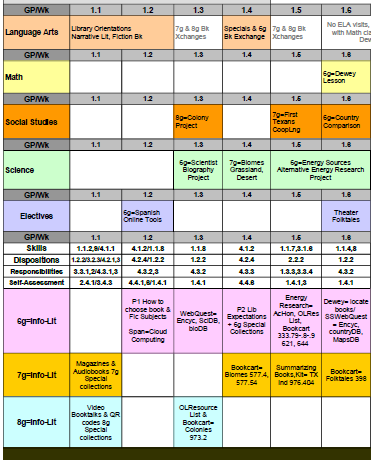 I’ve mentioned my Curriculum Matrix and how I use it to create my Library Lessons. I actually began it during my second year in the school library. The image at right is the overview tab of my Matrix spreadsheet.
I also have a tab for each grade level with every unit for every subject listed by week and grading period, with any school- or subject-wide testing dates, such as MAP and State tests noted. With these sheets I can scaffold grade-level skills across the different subjects within that grade, so I’m sure that, by the end of the school year, students will master all the necessary library skills for their grade level.
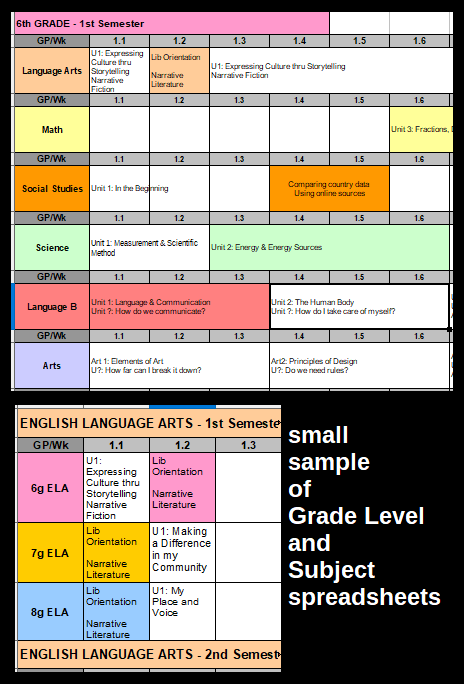 Finally, I have a tab for each subject across all 3 grade levels, again with every unit by week and grading period. With these sheets I can scaffold skills from one grade level to the next, building more complex and advanced skills upon what students learned the year before. This way I can be sure that students will fully master all the necessary library skills for middle school and are prepared for the increased demands of high school.
The Library Curriculum Matrix has been easy to identify the “essential” lessons of subject area teachers so I can create Essential Library Lessons. It has been so successful a way to scaffold my lessons and market specific lessons to teachers, that now my teachers seek me out for a library lesson if they even sniff an opportunity to visit the library during their units.
| You can find my Library Lesson Curriculum Matrix in No Sweat Library, my Teachers Pay Teachers store. |  |

Updated 2025.