
 Educators use a range of tools and resources to promote student learning. While we have many valuable digital tools, students never tire of good old cut-&-paste activities, and hand-crafted foldables are often the best tool to help students compile and organize new information.
In the School Library, they provide an opportunity for students to collaborate as they learn, and foldables also provide the teacher with an excellent quick assessment for a daily grade.
The vast chasm of time since I was in school prevents me remembering if foldables were part of my classwork, but once I discovered them as a teacher, I continually add new ones to my Teaching Toolkit. I encourage you to try my 4 favorite foldables for your School Library Lessons—they stand the test of time even in our modern digitized world.
THE BIOCUBE
Click to enlarge.
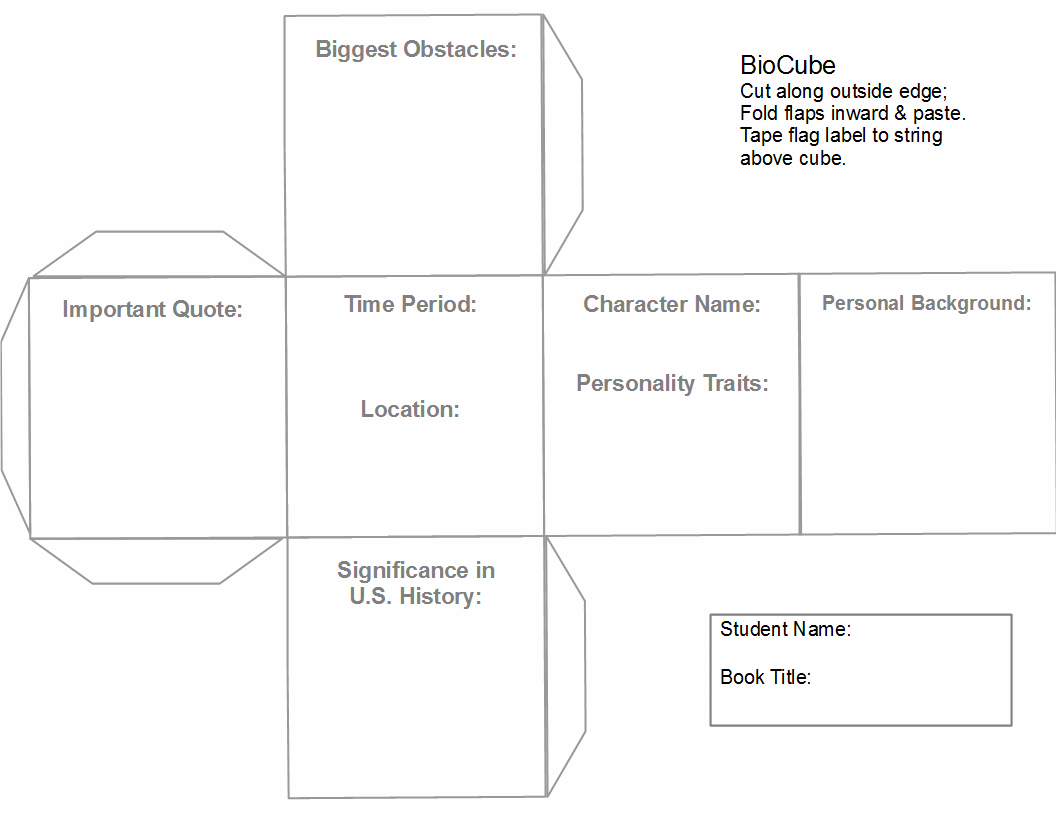
A very simple foldable is the biocube, an online tool on ReadWriteThink. I first used this when a new 8g ELA teacher discovered our sizable section of Historical America books that support 8g American History classes. Instead of doing a whole class novel tied to History, she wanted each student to read a different historical fiction book. When I suggested that, rather than a book report, students use higher-order thinking skills to create a BioCube Biography about an important character in the book, she was excited to try
Students use the ReadWriteThink biocube planning sheet to gather and refine ‘biographic’ information about their book’s chosen character:
- name and personality traits
- personal background
- time period and location of story
- significance in U.S. History
- biggest obstacle to overcome
- important quotation from story.
I adapted the RWT cube to fit our preferences, and copied the 2”x 2”x 2” paper cube onto colorful paper. Students write the condensed information about their chosen character on each side of the cube, then cut out, fold, and paste the pattern together into a finished cube. They attach a 2-ft. length of string to the cube, tape the label with their name & book title on the string just above the cube, and the cubes are suspended from acoustic ceiling dividers with a bent paper clip. The project is fun for students and the hanging cubes are a real conversation starter for visitors to the ELA classroom.
THE BASKET-WEAVE
Click to enlarge
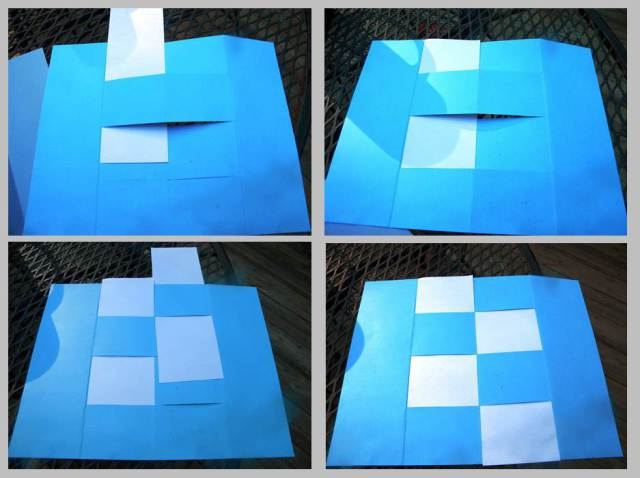
This unique foldable book was introduced to me by a new 7g Social Studies teacher for a Jigsaw cooperative learning activity using our Texas Native Nations library books and kits. Created with one color of letter-sized paper and a second ½ sheet in a contrasting color, the foldable has front and back covers, 2 inner flaps, plus 6 woven pages that are perfect for summarizing information: 2 on the front, 2 on the back, and 2 “secret hidden” pages, as shown in the picture below.

Photos courtesy of Mary Williams, Math Teacher, Midlothian HS, Midlothian, VA. For more great foldables, see her blog at https://mrswilliamsmath.wordpress.com/.
In the classroom, the teacher creates learning groups and students weave their book. On the left inside flap they list the 4 cultural aspects of Texas Native Nations. I prepare the Library Lesson by organizing materials for each of the six Native Nations on a separate table. When the class arrives, each student in a group goes to a different Nation table and works with students from other groups to summarize information about each cultural aspect down one column of their foldable.
After a suitable time, students rejoin their original learning group to share their gathered information with each other. Students record information about the other 5 Native Nations onto their foldable columns. Students then collaborate to compare/contrast, across a row, the information for each cultural aspect and and summarize it on the right inside flap. At the end of the period, every student has the information needed to pass the open assessment given the following day, during which they can use the basket-weave to help answer questions.
This foldable is perfect for jigsaw cooperative learning, plus every year a few students discern the connection between using a basket-weave for learning about Native Nations. Creating and using this foldable is so much fun that students keep it long after the unit is finished, which they wouldn’t if it were just a sheet of paper.
THE ACCORDION BOOKLET
I learned about this foldable at an International Baccalaureate workshop for Middle Years Program Librarians. It is so flexible it can be used for any subject or purpose depending on which size paper is used and how it’s folded. The original student examples I saw—for an ELA Shakespeare project and a Social Studies project—were 8½″ x 14″ paper for the accordion and construction paper for the covers.
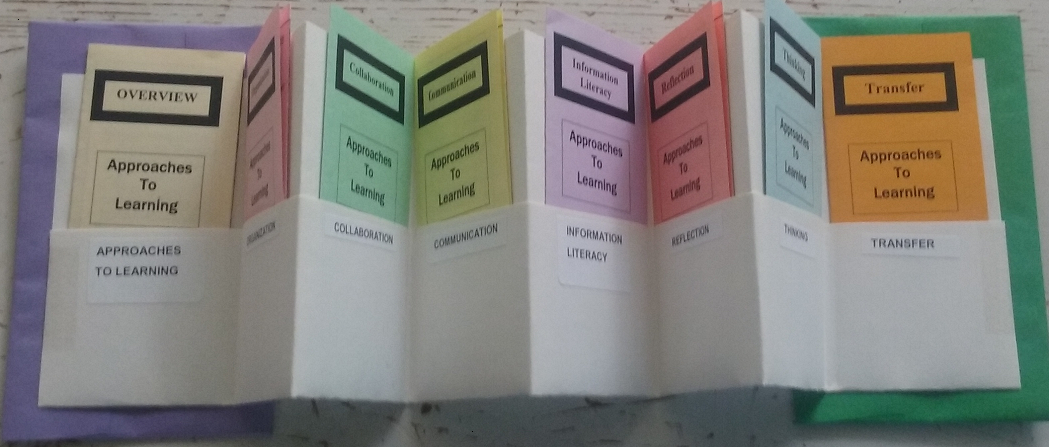
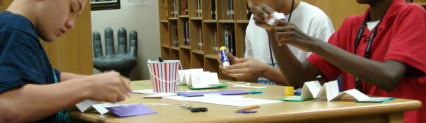 For a series of Library Lessons on learning skills, we use 11″ x 17″ art drawing paper (stiff, but not as bulky as construction paper) cut in half lengthwise for the accordions, with the bottom third folded up for a pocket, and 3″ x 5″ index cards covered in bright color paper for the bookends.
As I show students how to cover the index cards with paper, I mention that this is exactly how the hardback covers are made for our library books. As we glue the end segments of the folded accordion to the inside of the cards, I remark that this is the same way the endpapers of a book are pasted to the book cover. These tidbits of information always prompt a couple kids to walk over to the bookshelves and grab a book to see what I’m talking about!
At ensuing library visits I give students a small memento at the end of the lesson to put in the corresponding pocket of their booklet to remind them of their learning. Some are useful, such as a large colorful paper clip, and some are fun, like a peppermint hard candy!
Click to enlarge
Teachers liked the student accordion booklets so much that I created IB-MYP Toolbooks for them, which hold small brochures of information about the program’s Approaches to Learning. They love using this compact tool during lesson planning to quickly determine which skills they can include.
THE TIERED OR WATERFALL FLIPBOOK
Click to enlarge.
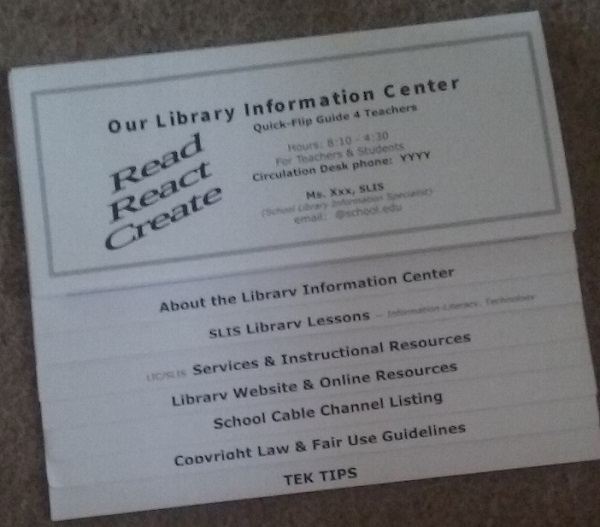
The beauty of this foldable is that it can be as simple as a single sheet of letter-size paper glued down into an interactive notebook or as complex as the 4 sheets of 8½″ x 14″ paper I use to create my Library Guide for Teachers. The professional document did take considerable planning, but a student project can be much simpler.
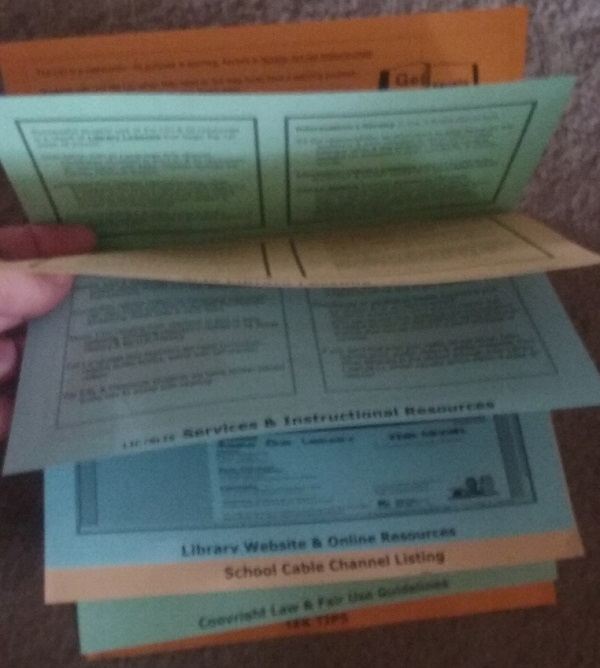
An easy way for students to create this flipbook is to fold a sheet of paper so the bottom edge of the top section is offset about ½″ above the bottom edge of the back section. Add an outside page so the bottom of the sheet extends below the original by the same offset, then fold over the top sheet so it ends above the first by the same offset. Keep adding an outside page to reach the total number of ‘flips” desired.
Click to enlarge.
The top flips do get progressively smaller as you add sheets, so there is a limit to how many sheets can be used effectively. Once the sheets are tightly creased, staple them together at the crease with an extended arm stapler. Alternatively, you can carefully glue each inner sheet to an outer sheet at the crease. Use different colors of paper to make it pop, as I do for my Library Guide for Teachers.
For younger middle school students we keep it very simple—just 1 or 2 sheets—with the teacher or I designating what students will write/draw on each flipsheet. Older students can plan their own publication depending on how much space they need for each part of their project.
THE FUTURE OF FOLDABLES
 These 4 foldables are very popular with our middle school students. A Google Image search for “foldables” can give a school librarian or a teacher these templates and a myriad of other great foldables to use.
I consider foldables similar to graphic organizers, and I can’t imagine they’ll ever fall out of favor. Even with the ubiquity of smartphones, tablets, laptops, and desktop computers, there will always be a place in education for simple cut-and-paste activities that challenge students to learn and think critically and creatively.
Updated 2025.



Hi BrP,
I love these ideas.There’s something about these sorts of hands on activities that students really seem to enjoy.
I’m currently on family leave from full time teaching but do a little relief teaching. These sorts of activities would be perfect for that.
A similar idea that I’ve used with my primary school students is creating an 8 page booklet out of only scissors and an A3 piece of paper. It looks like this. https://bookzoompa.files.wordpress.com/2010/10/bookbasecolorw.jpg You might have a seen it.
I also find these foldables can sometimes integrate well with tech. So they can use their devices to research their topic, then summarise in their booklet. A fun mini project!
Thanks for more great ideas!
Kathleen
I, too, have used your foldable book. It’s a great little tool for unit vocabulary or concept illustrations, especially with ESL/ELL students.
And I also loved being home with my own kids–many of the best strategies and activities I used when I returned to the classroom were things I’d honed with my own children!