Every school librarian experiences the teacher who comes in with a new idea for a library visit—something they did at their previous school, a suggestion from a book/curriculum guide, or a great project they heard about at a meeting or conference. How do we decide whether we can accommodate this teacher’s request? Over the years, here’s what I learned:
We can’t discourage teachers from bringing us lesson ideas, but they can’t expect us to instantly put together a lesson.
So, when a teacher approaches me about an idea, I grab a Library Lesson Collaboration Form and use it to fill in information as they tell me their proposal. Then I ask them these 2 questions:
- Can I learn more about this from a book, handout, Website, or lesson plan?
- Can I have the rest of the day/until tomorrow/a couple days to make sure we can meet the needs of the visit?
I find that this response is better than a simple yes or no, because the teacher sees I’m taking their suggestion seriously enough to investigate it. Having some time to cogitate helps me put everything in perspective and to prepare myself for the next conversation with the teacher. When I return to them with “Yes, let’s do it!” and what we can do together (or “Sorry, this isn’t possible because… but we could do this instead.”), they are impressed and I create the pattern for future dialogue.
ASK THESE QUESTIONS TO DECIDE
Using info on the Library Lesson Collaboration Form, I begin my ‘thinking-time’ by asking the same question I ask for all my school library decisions: How will this impact student learning? Does this lesson:
- Promote reading?
- Promote problem-solving?
- Support the subject and the library curriculum?
If I can answer ‘Yes’ to any of those questions, I know the lesson can have a positive impact on students.
However, I also need to consider the library, so I ask myself this question: How will this lesson impact library management? How does it affect…

- Collection development
Do we have the materials for the lesson?
If we don’t have materials, do I have enough time to gather them through Inter-Library Loan?
If I purchase materials, will they be used again? - Facility
Can we accommodate this lesson in the library?
Do we have the audio/video/digital equipment needed for the lesson?
Will we need to rearrange the facility or bring in anything else for the lesson? - Library schedule
How much time will students need in the library?
Will this be a single visit, or do we need more than that?
Is the teacher flexible with the timing of the visit, or must it be within a certain time frame? - Library Promotion
Do we need involvement by other teachers, administration, the district, the community?
Will this lesson advertise the library program in a positive way? - Professional development
Do I have the expertise to do this lesson?
Can I get help from another district librarian or on one of my listservs?
Answers to those questions determine preparation time/effort and whether it can be accomplished before the teacher wants the library visit. I may need to offer suggestions about how to implement or improve their original idea, which is a delicate process:
We don’t want to patronize teachers, but rather use tact to infuse their idea with what we know is best library literacy practices and guide the lesson toward student-centered inquiry.
If the lesson request is a viable one, I transfer the Request Form information to the Library Lesson Planner and fill in how I can implement the lesson. Usually when the teacher sees my Library Lesson Plan with detailed consideration of their idea, they readily accept my suggestions and appreciate the work I’ve put into making their idea come alive.
AN EXAMPLE OF IMPLEMENTING A TEACHER REQUEST
 Our 6g Multicultural Folktales Unit is an example of how a teacher request became a multi-visit ELA/Librarian collaborative unit. It began as a single-visit idea from an English Language Arts student teacher. Our collaborative lesson was so successful with students that the following year the ELA teachers asked to repeat it.
I suggested that we have a second lesson visit to extend their content immersion, and teachers accepted. The next year I suggested a third visit where teachers could introduce a student project and take advantage of the library’s resources. Now this entire unit is a truly joint-taught collaboration between 6g ELA teachers and the School Librarian.
We use multicultural folktale picture books because they can be read during a single-period library visit and even struggling readers can do the lessons. Initially I borrowed from elementary schools, but purchases now allow me to host two ELA classes together for the lessons. (Theater and art teachers also use them for projects, so they were a good investment.)
1st Library Visit – Multicultural Cinderella Fairy Tales
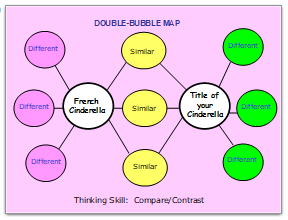 We introduce plot and story elements using the fairy tale Cinderella as an “exemplar.” As the teacher presents story elements and each plot element, I read aloud the pertinent segment from the traditional Perrault Cinderella story. Then, student partners read one of the multicultural Cinderella picture books from their table and use a double-bubble graphic organizer (the daily grade) to compare/contrast story elements of the original French story with their cultural version. I have some very humorous Cinderellas, so even boys enjoy this activity.
2nd Library Visit – Multicultural Folktales
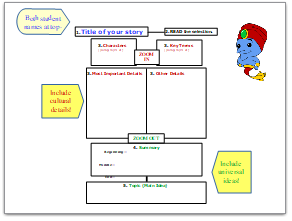 A week later we introduce unity vs. diversity of cultural beliefs, customs, and traditions with the 5 types of folktales—myths, fables, legends, tall tales, and fairy tales. The activity is similar to the earlier visit, but with deeper examination of a story. Student pairs choose a folktale picture book from their table and, as they read it, use a ZIZO graphic organizer (daily grade) to “Zoom In” on the cultural details of their particular tale and “Zoom Out” to glean the universal ideas common to every culture.
3rd Library Visit – Personal Multicultural Folktale
 At the next visit, a week later, I begin in the oral storytelling tradition of folktales, by relating “Little Dog Turpie and the Hobyahs”, an Old English tale I learned from my grandmother, using dressed pipe-cleaner dolls as storytelling accessories (also from my grandmother). Then teachers introduce the student project using the project guide/rubric worksheet and while they elaborate on the presentation choices, I show those other examples so students know what is expected.
Students will create their own cultural folktale, including cultural story elements and unity/diversity principles, and then present it in a unique way:
- tell it orally with an accessory
- make a book, handwritten or digital, with a handmade book cover
- create a graphic story, by hand or digitally
4th Library Visit – Presentations & Folktales to Fiction
About a week later students are ready to present their folktale project. Depending on variables, we may have this in the library or the teachers handle it in the classrooms. Typically the oral storytellers are interspersed with “book” browsing on desks or tables so students have a chance to move around. Not only do 6g ELA students enjoy this project, but it coordinates with their study of World Cultures in Social Studies.
 I give the 4th lesson of the unit either at the presentation visit or at their next regular scheduled library book visit. I offer the premise to students that folktales may have “morphed” into the different kinds of stories in Fiction books. Students and teachers are fascinated by this idea, as are other librarians. (I’ve done some research which seems to support it.) After the excitement of the multicultural unit, this lesson excites students into expanding their reading choices of fiction books!
Continuing the “Story”
The 7g ELA teachers were impressed with our project options and began offering similar choices for their mythology unit project: a diorama or mobile illustrating a created myth (which we display in the library), a narrated group pantomime, or a compare/contrast interview with a “mythological” actor, pop star or sports figure. The interactive choices particularly appeal to 7th graders, who need movement and peer interaction.
| If you are interested in part or all of the Multicultural Folktales Unit, you can find them at No Sweat Library, my Teachers Pay Teachers store. |  |
 |
|
The Folktales to Fiction lesson is part of the Bonus for the Unit Bundle. |
 |
 |

Updated 2026.