Do your teachers use Reading Logs to document student reading? Does your “school policy” dictate that teachers employ reading logs with students? If so, you—and some of your teachers—may be asking these questions:
- What is the purpose of reading logs?
- Are some reading logs better than others?
- What are the alternatives to reading logs?
If you were an elementary or ELA teacher before becoming a School Librarian you may accept reading logs as a normal part of the classroom experience. I’m a School Librarian from a different subject background, and I have some concerns about this practice. I’m sharing some improvements and alternatives that a School Librarian can use to increase the value of student independent reading.
THE PURPOSE OF READING LOGS
Many teachers believe a reading log is a good way to develop students as readers:
- They keep track of books they’ve read and which ones they liked.
- They learn which kinds of stories (subjects/genres) they prefer.
- They self-assess and understand themselves as readers.
- Teachers can dialogue with students about their reading.
These are admirable purposes, but too often the result is forced daily reading and recording the number of minutes and/or pages on a chart, to be signed by a parent, and turned in to the teacher. I saw hundreds of these during a quick image search, and here’s a typical layout:
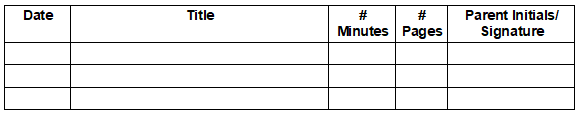
Unfortunately, this type of reading log doesn’t really fulfill any of a reading log’s intended purposes!
Such reading logs were the topic a few years ago on Scott McLeod’s blog “Dangerously Irrelevant”, based on a blog post by parent Lisa Morguess, who had this to say:
- A reading log says, “I don’t trust you to read.”
- They turn reading into a chore.
- Time spent matters more than content or understanding.
- This is not learning – it’s obedience.
There were dozens of comments on both posts, and commenter Mark was particularly anguished:
I shudder at the very recent memory of my 5th grade daughter proudly bringing me her reading log to show me how much she had read this week and then, of course, get me to sign it. My daughter loves to read, but now her pride is…her log, rather than discussing her books in great detail as she did just this past summer, when there was no log.
As a School Librarian, I believe this type of reading log is not about students at all–it’s about teacher accountability. How else can a teacher “prove” that they are “teaching” kids to “love reading”? For many years we had free reading at our school with great success. One year teachers were told to have students “document” the time they were reading by filling out reading logs and using weekly bookmarks with daily questions to answer. To comply, some teachers even began to dictate what kind and how many books students must check out at their library visits. Well, that year our state test scores dropped, and some of our best ELA teachers left for less rigid environments. All the fun had gone out of reading, so the next year we went back to free—and undocumented—reading (and our reading scores went back up)!
SOME READING LOGS ARE BETTER THAN OTHERS
 As a Middle School Librarian I realized students do like to keep track of books they read, so I created a simple Reading Record with space for the title and author of the book and a star rating for students to indicate how much they enjoyed the book. It wasn’t required and the forms were on the circulation desk for students to put into their binder. This type of record isn’t discouraging—it builds pride in a personal accomplishment.
Then, four consecutive developments prompted me to re-evaluate reading promotion:
- We became an International Baccalaureate school, which encourages global-mindedness.
- I reorganized our Fiction area by Subjects (genres) using pictorial spine stickers and color transparent label covers.
- The district English Language Arts department launched the Reader/Writer Workshop model with students using Interactive Notebooks.
- Our district Social Studies department instituted Interactive Notebooks and advocated more content area reading that supported their curriculum.
I could see an interconnection and devised a new strategy to promote more—and better—independent student reading. First, I identified more Fiction books with multicultural characters and added relevant spine stickers. While reorganizing Fiction, I created 3 Special Collections for Social Studies, one of which focused on global books. Finally, I modified my Library Orientation Lessons to incorporate the wide variety of reading options and created brand new Reading Records:
- For ELA, a legal-sized sheet for students to fold in half and paste into their Interactive Reader/Writer Notebooks:
- a table with images of the 8 main Fiction Subjects;
- a table with images of 5 Multicultural labels, a national Awards composite, and our State Reading List label;
- a table with images of the grade-level Social Studies options so students (by agreement between teachers) could enter the same Narrative Fiction and Expository Informational books for both classes.

- For Social Studies, a letter-sized sheet for students to paste into their Interactive Notebook, one for each course:
- a table for 6g with images of the continents identifying our GlobeTrekker collection
- a table for 7g with reading options for our (Totally Texas) Sensational State collection
- a table for 8g with reading options for our Read America collection
- For my store, I added a table with 7g reading options for those states who study World History Ancient Civilizations instead of State History
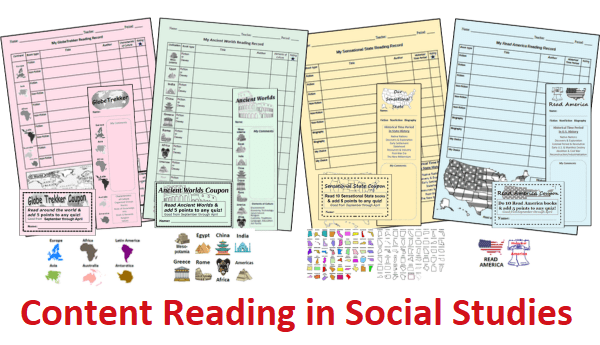
My ELA teachers are elated with their new Reading Record and prefer it over the one provided by the district. Social Studies teachers also appreciate their customized Reading Record to promote content area reading. Now, I copy and distribute enough Reading Records to ELA and Social Studies teachers so each student can paste one into their Reader/Writer and Interactive Notebooks when they create them during the first week of school.
ALTERNATIVES TO READING LOGS
To help students locate and keep track of similar kinds of stories, I’ve created topical bookmarks. Copied to both sides of colorful card-stock and cut apart, I provide over 2 dozen different bookmarks to students, and they’re a big hit. Some students use the same topical bookmark over and over, so they can track books read by crossing off titles as they read them. Other students use them as a search tool, choosing a new one each time they visit to try a new book topic. Not only are these so much more useful to students, they cost a whole lot less than the commercial ones from library suppliers!
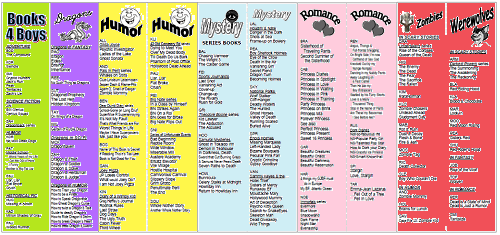
Colorized examples of topical bookmarks
Our Reading Recovery teacher has been especially pleased with the customized set of bookmarks I made for the four reading levels of her students: Laying the Foundation, Building My Skills, Mastering My Skills, and Skillful Reader. Our books aren’t labeled with levels, so I created a bookmark for each reading level listing appropriate lower-Lexile titles. She keeps them in her classroom to distribute as kids move up in their reading ability. The titles aren’t required reading, but suggestions, and students feel comfortable using the bookmarks to browse for and choose their books.
While reading the comments on the blogs mentioned above, I thought Mike F’s comment would be a cool idea for older students:
I love an alternative model from Jim Mahoney in his awesome book, Power and Portfolios. He does “literary letters” where students write more deeply about what they are reading and thinking, and exchange letters with classmates about once a week.
BUILD A BETTER SCHOOL LIBRARY READING PROGRAM
Student Reading Logs can be horribly discouraging for students or they can be valuable enhancements to any ELA reading program. A perceptive School Librarian can see the benefits of content-area reading and go beyond ELA, developing collections and tools that will make a well-rounded School Library Reading Program praised by subject-area teachers, and enjoyed by all students.
| Increase independent reading & improve student achievement, with these products in my No Sweat Library store on TeachersPayTeachers. |  |
 |

Updated 2026.