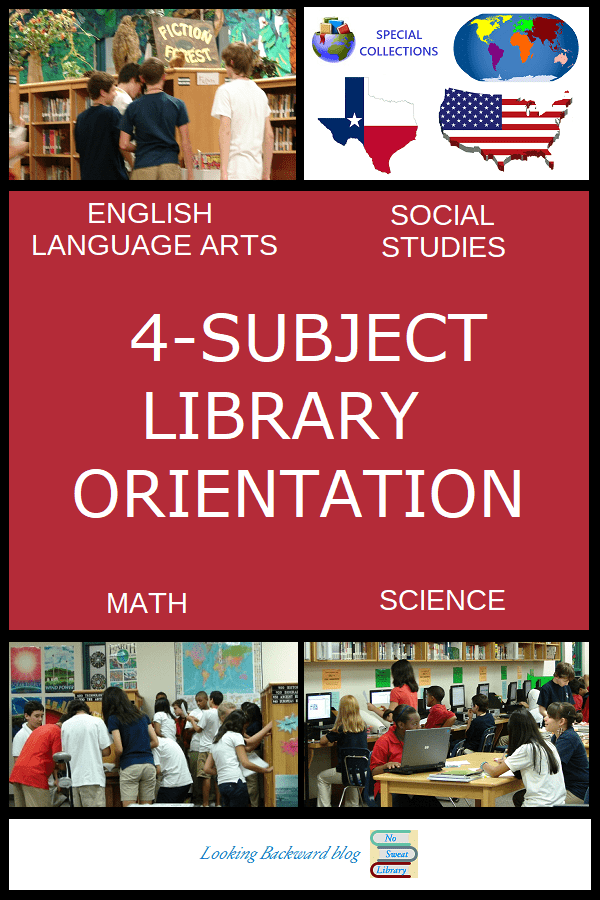
 School Librarians know the importance of our students’ first library visit, so at the beginning of each school year, “school library orientation” becomes a hot topic on library listservs, social media, and blogs. Folks request ideas, asking, “What can I do differently this year?”
A couple years after I simplified and customized my school library orientations with English Language Arts classes, I came to an astounding realization:
EVERY subject-area’s “first” library visit of the school year is a “library orientation” for THEM!
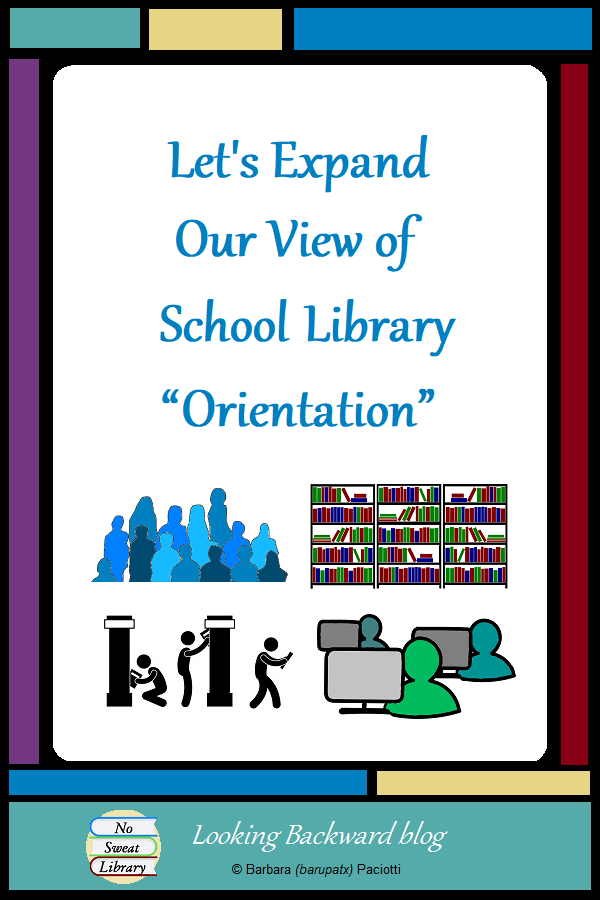
I’m suggesting that you don’t need to keep trying new things every year with the same subject class. Rather, expand your view of what “library orientation” means and customize an “orientation” lesson for every grade level and subject area in your building!
Allow me share how I developed a series of “library orientations” that brought 6th grade ELA, Social Studies, Math, Science, and Elective classes into the library at various intervals during the first several weeks of school. Once you try this, I know you’ll love it, and your subject area teachers feel pretty special having their very own unique library orientation customized to their content. (Even an elementary librarian can focus each class’s visit on new library materials or features, so it’s a like another orientation.)
ENGLISH LANGUAGE ARTS “ORIENTATION”
I’ve written about how I simplified my 6th grade library orientation, so students aren’t overwhelmed with too much new information. Keep in mind that for lowest-grade-level, new-to-the-school students, our school library is completely new to them, and our lesson is “fresh” for them, even if we’ve done it a dozen times! Because each new year is a totally new group of students, I’m as enthusiastic about this lesson as I was the first time.
Our ELA classes begin the year studying narrative text, so we focus on how to choose one good book from the new-to-them Fiction area. My lesson is followed by plenty of time to browse the Fiction area of this “new” library, after which we have extended silent reading while I do a quiet invited checkout. This standard procedure establishes a reading culture for ELA’s every-other-week library visits for the rest of the school year.
SOCIAL STUDIES “ORIENTATION”
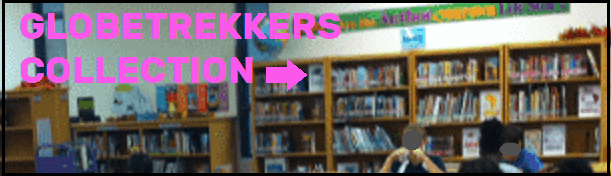
After the ELA visit, we can bring in other 6g subject-area classes and do a “library orientation” customized to their particular content. I’ve written about my Special Collections for Social Studies, so I have 6th grade Social Studies classes visit a couple weeks after ELA to learn more about their “new” school library: the GlobeTrekkers Special Collection of fiction & Dewey books that support their study of World Cultures.
The first part of the lesson is returning books and a library expectations lesson, giving students a few policies & procedures for their “new” school library. Then I introduce Content Area Reading and why it is important.
Educators have learned that reading comprehension isn’t so much about word recognition as it is about conceptual understanding in context. That is, students become better readers as they accrue background knowledge of various topics, so the more they read, the more they know.
Yes, Dr. Seuss instinctively told us this years ago in his book
“I Can Read With My Eyes Shut!” and it just took brain researchers a while to confirm that.
Now I don’t tell all this to kids…I just tell them that the more GlobeTrekkers books they read, the better they’ll do in Social Studies and get better grades!
I show them how to identify GlobeTrekker books in the search results from our online book catalog, and when they hear they can check out a GlobeTrekker Dewey book and, if needed, a new fiction selection for their ELA class they are excited to begin browsing. We follow the same procedure—silent reading & invited checkout—which reinforces with Social Studies the reading culture that was established with ELA.
MATH “ORIENTATION”
I’ve also written how it makes sense to do our Dewey lesson with math classes which has students locate decimal numbers on the bookshelves. When 6th grade Math classes enter the library, students are so puzzled about what they are doing here…with their math class? That, in itself, sustains engagement for students—who apparently have never done anything like this before.
Keeping the lesson focused on numbers makes it easy for students to relate the Dewey number they see in a book search to a location on a shelf, regardless of the topical content of the book. After the lesson there is plenty of time for students to browse for up to new books, either Fiction or Dewey depending on what they already have checked out. The 6g boys are especially eager to find their favorite informational books in this “new” school library: aliens, cars, sports, and drawing, as well as the Guinness and Believe-It-Or-Not books. And we continue our standard reading & checkout procedure, which reinforces with Math the reading culture we established with ELA and Social Studies.
 Three customized lessons with 3 different subject area classes have progressively given our “newbies” what they need to effectively use their “new” school library.
- We have imparted our policies & procedures when applicable, so students are not overwhelmed with too much new information to remember.
- We have established our school’s reading culture of silent sustained reading (we call ours DEAR—Drop Everything And Read).
- We have gradually built up the number and type of books students can check out, so during the early weeks of their new school experience they needn’t keep track of too many books.
SCIENCE “ORIENTATION”
By now our 6th grade Science classes are well into their unit on Energy and are ready to begin their project on alternative energy resources. The timing is perfect for an introduction to our online subscription services for middle school, which are completely different from those in elementary school.
Most “newbies” come to us from feeder elementaries, but many are new-to-district students. Thus, I begin this “online library orientation” with Digital Citizenship and direct students to our online library resources webpage to prepare for the WebQuest lesson.
I’ve written about my guided WebQuest that introduces just 3 subscription services to 6th graders—an encyclopedia, a periodical database, a topical reference e-book—with each segment looking only at the specific features of a service they’ll need for the project.
This is a full-period lesson, and each segment has students reading for content information and citing sources as they fill in the WebQuest worksheet (or HyperDoc). Students come away well-prepared to research their project, and I also provide a cart of books for the classroom to supplement the online tools.
To illustrate how favorably teachers respond to customized lessons, shortly after this, 6g Social Studies has an “online orientation” WebQuest using our countries of the world databases. Students gather country data into a spreadsheet app for comparison, and then learn to automatically generate a graph.
ART & SPANISH “ORIENTATION”
By this time we are through the first 9-week grading period, yet I’m not quite finished. Remember, any subject-area class that visits the library for the first time gets a “library orientation.” So, I begin the second grading period with a customized orientation for 6g Art and 6g Spanish. Because these 2 subjects alternate semesters, all 6g students receive this lesson during the first semester.
Both these lesson visits introduce Cloud Computing & Netiquette featuring our online email service. It is a guided lesson, similar to the WebQuest, that examines 3 features of the service: email, blogging, and discussion forums. I always let the other 6g teachers know when I do this popular lesson, so they can begin using the service for their own courses.
INFORMATIONAL CONTENT “ORIENTATION”
 I’ve written, too, that making ELA and Math orientations about location allows me to bring other subject areas into the library for content-specific lessons. During the second grading period, 6g Science returns to the library during their Classification & Organization unit.
The lesson allows students to explore the Dewey 590 Animals section, whose disciplinary organization mirrors that of scientific classification, thus reinforcing content for both science & library. The lesson also reviews the parts of informational books so students learn ways to dig into a book’s content to find and extract what they need.
HIGHER GRADE LEVEL “ORIENTATIONS”
Lest you think I ignore our 7th and 8th graders, here’s a list of the “library orientations” I’m providing for them during this same time period:
- 7g & 8g ELA – Narrative Fiction & first book checkout
- 8g Social Studies – The American colonies, a U.S. History project
- 7g Math – adding/subtracting decimals & locating Dewey numbers
- 7g Social Studies – First Texans, a TX History cooperative learning activity
- 7/8 Theater – Multicultural folktales, creating one-act plays
- 7g Social Studies – WebQuest on European explorers, a TX History project
- 8g Spanish – Weather reports & introduction to video broadcasting
- 8g Health, 8g Careers – books, ebooks, online services & websites
I know you may not think of these as “orientations,” but if view each library visit as an entirely new experience for that group of students in that subject class, all our lessons become “library orientations.”
THE POWER OF “SCHOOL LIBRARY ORIENTATIONS”
I’ve discovered it doesn’t matter how good a librarian students have had before they arrive in our school. These “library orientation” lessons are always powerful because they are bite-sized pieces, scaffolded over time, helping students gradually learn—and remember—how to use every aspect of our library services.
To make successful, carefully crafted lessons, we must have a comprehensive view of each grade level’s total library experience, for both subject-area curricula and the library curriculum. I created my Curriculum Matrix for just this reason, and I keep it updated so it is always ready to be referred to.
Our attitude toward “library orientation” is a reflection of our mindset about our entire School Library Program. We want every student experience with us to be a memorable one, offering meaningful lessons that never get old.