Bulletin Boards & the School Library

Bulletin Boards & the School Library - Bulletin boards can be more than decorative: they can be our school library's primary means of advocacy and PR. Read how this School Librarian makes them purposeful without spending a lot of time or money! #NoSweatLibraryWhen I began my School Librarian position, I didn’t have any bulletin boards and I didn’t care—I didn’t see the point in “cutesy” bulletin boards. Rather, I focused on decor for the rather bare 2-year-old library, installing purposeful posters and informational signage. One day I realized that folks had to decide to enter the library to see what’s there, and if I had bulletin boards outside the school library, I could entice students and teachers to make full use of everything the library had to offer.

Now, Bulletin Boards are my primary way to promote the School Library to students, faculty, administration, and visitors! It doesn’t cost much because I don’t use prepackaged theme pieces; instead I create my own signage with slide presentation software that allows for a variety of text and graphics on 11″ x 8.5″ signs. I print them in color and laminate so they can be reused from year to year.

For any bulletin board, what we display and how often we update depends on how many boards we have and where they are located. By designating certain bulletin boards for certain purposes, and carefully planning for long-term display, we can minimize the time needed to create and maintain them, yet still have them convey valuable and relevant information.

IN-LIBRARY BULLETIN BOARD

The first bulletin board I installed was a 3′x4′ one inside the library, on a wall next to the circulation desk. I put up a calendar for planning class visits, but after switching to an online library calendar that could be viewed by anyone in the building, I turned the bulletin board into a place to display the “nuts & bolts” of my Library Program so our operation is completely transparent to visitors. This board is all business, but that’s its purpose, and the infrequent updates are quite easy to do. Signs and items on the bulletin board include:

  • Library Program Mission Statement – This sign typically stays the same for 2-3 years, and reflects my current Strategic Plan.
  • My Professional Information Literacy Theme – I create a new Info-Lit theme when I rewrite my Strategic Plan. It’s my personal goal for focusing Library Lessons to integrate with classroom subject content and new technology.
  • Monthly Library Schedule – I simply print this out from online calendar the first day of each month. Anyone can see who’s scheduled for library use, and I can pencil in notes when planning with teachers.
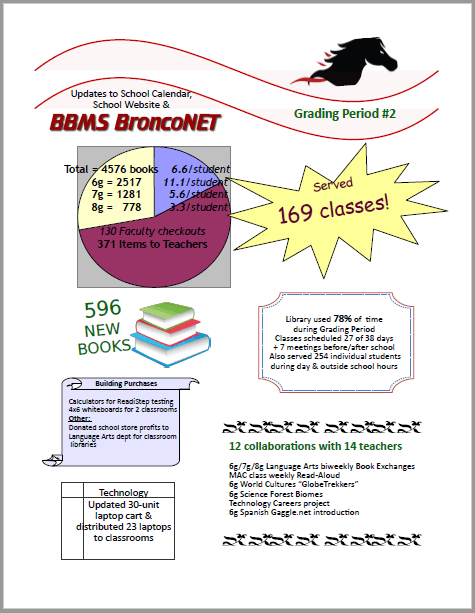
  • Looking Back @ Bulletin Boards & the School Library - Bulletin boards can be a school library's primary means of advocacy and PR, yet we can make them purposeful without spending a lot of time or money! Read how... #NoSweatLibrary #schoollibrary #bulletinboardsLibrary Activity Report – This is an infographic I create at the end of each 9-week grading period. I submit one copy to the principal and mount one on the bulletin board.
  • Public Library News & Events – Our school area includes 2 different city libraries and their Youth Librarians provide me with info and flyers, especially for the start of the school year and before each school break.
GRADE LEVEL BULLETIN BOARDS FOR SUBJECT CONTENT

Create a Unique Library Bulletin Board For Each Grade Level - Teachers appreciate school library bulletin boards coordinated with their current subject content, and students, as they move between classes, will constantly be reminded of library resources to help them with their assignments. #NoSweatLibraryOur school library is in the center of the building, surrounded by four hallways, so I mounted a 4′x4′ bulletin board in each of the three hallways that border our 6th, 7th, and 8th grade wings to promote reading and using the library.

I designed a sign system to set them up at the start of the school year and not have to redo them, yet I can change individual signs to coordinate with subject area classroom activities during the school year. Each bulletin board includes a series of customized signs:

  • A grade-level Information Literacy Theme sign that reflects my lesson focus for that grade at the top left corner.
  • A grade-level English/Language Arts Unit Theme sign in the center. This sign changes for each 9-week grading period.
  • A grade-level Social Studies Theme sign in the bottom right corner to promote their Special collections: “Read Around the World” for 6g, “Read Your Way through Texas History” for 7g, and “Read America” for 8g. I keep bookmark pockets filled with reading log bookmarks for this reading promotion program.
  • I add smaller signs for other subject area classes that visit the library during the grading period, like infographics of online services for research projects. These change each grading period, too.
  • Students can create a book review on a 3″x5″ index card and staple it on the board. It’s a great way to involve students and to update bulletin boards without a lot of extra work.

Teachers really appreciate that I coordinate these bulletin boards with their subject content, and students constantly see them as they move between their classes.

MONTHLY THEMATIC BULLETIN BOARD

Share a Library Bulletin Board with Monthly Themes - Here are 8 themes for a school library bulletin board that I share with other staff members so I only have to do 2 different months of decorating! Learn how you can do the same. #NoSweatLibraryThe 4th bulletin board is located in the hallway near student bathrooms and is visible to nearly everyone on their way to the cafeteria. I share this 4′x4′ board with others so we can have a new theme for each month of the school year yet I don’t have to do it every month.

Heritage displays

September is decorated by our Spanish teachers and student Spanish Club for Hispanic Heritage Month, February is decorated by our Black History Month Committee (which includes students), and May‘s Asian/Pacific American Heritage Month is decorated by our ELL teacher and her students (we have a large Asian population in our school). April has recently been deemed Arab-American Heritage Month, honoring those from the Middle East and North Africa.

All these groups use wonderful accessories to dress up and draw attention to the board and share classroom activities. I support that by displaying books inside the library that coordinate with each heritage, such as related biographies and authors.

November is Native American Heritage Month, and I use the board for an Indigenous Peoples Around the World display to bring awareness of this issue and support our IB program. I create the display by continent and post signs with historical insights or quotations, along with pictures of book covers of our indigenous collection, including books by and about Native Americans.

Topical displays

The March board is handled by the Fine Arts Department to feature Music in Schools Month and Youth in Art month. The April board is handled by the Math and Science teachers for Math Awareness Month and Earth Month, which includes highlights from our student Recycling Club. October is National Bullying Prevention Month and National Red Ribbon Week. Our school counselors—and student office aides—take on the bulletin board since they sponsor Red Ribbon Week and bullying also falls under their purview.
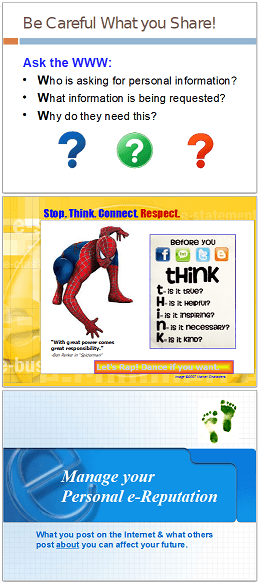
Internet Safety Month: Be Safe in Cyberspace & Become a Responsible Digital Citizen - The 3 different lessons I have for 6g, 7g, and 8g students.December is a short month with our winter break, so I post coming activities at our public libraries to encourage students to visit the library and continue reading during the break.

January is for our district Internet Safety Month, during which all librarians present lessons to our schools. National Internet Safety Month is actually in June, but since we aren’t in school, our district has chosen January for these important lessons with the theme Be Safe in Cyberspace and Become a Digital Citizen. In addition to the board, student-created posters from my Library Lessons are displayed around the hallways.

The monthly thematic bulletin board is popular with teachers, especially those who otherwise don’t have a public bulletin board on which to display their subject content classroom activities. Because students contribute to these displays, they are more meaningful to all students.

GET MORE!
FREE Resource for my Email Group! - Subscribe to my mailing list and you’ll gain access to this FREE Purposeful Library Bulletin Boards eBook and other resources in my exclusive e-List Library. And you'll also receive a direct email for each new blog post. #NoSweatLibrary


Join my mailing list if you want more information about these bulletin boards! You can download my Purposeful Bulletin Boards ebook, which includes 15 Info-Lit and ELA signs.

You can also choose other free downloads from my e-List Library resources.

As a subscriber, you receive email notice of each new blog post covering school library lessons and management.

line of books laying down - indicates end of blog article


Join my mailing list to get a brief email about new posts on library lessons & management. You'll also gain access to my exclusive e-Group Library of FREE downloadable resources!


How Simplifying Library Orientations Will Simplify Library Management

Simplifying my Library Orientation Lessons has had a profound effect on how I manage my school library scheduling, facility organization, collection development, library promotion, and even my own professional development. You can simplify your school library management using these ideas! | No Sweat LibraryI’ve written about my simplified Library Orientations with English Language Arts classes, that focus only on reading and narrative literature. Students check out their first Fiction book and we establish DEAR time with silent reading as the pattern for every book exchange visit. Eliminating everything else from orientation gives students a pleasurable visit and makes ELA teachers avid library supporters.

From the very beginning, I began to see that simplified Library Orientations also simplify Library Management: scheduling visits, facility organization, collection development, library advocacy, and even my own professional development. My whole approach to our School Library Program became simpler, more focused on what students actually need. Let me share some details and you will want to simplify your program, too.

SIMPLIFIED LIBRARY SCHEDULING

One simplification of my Library Orientation was establishing sustained, silent reading (SSR) so students can begin reading their book choice, during which I do a silent book checkout by individual tables. The result is that students are more quickly engaged in their story, are reading more, and need to exchange finished books for new ones more often.

Having DEAR Time during library visits convinced ELA teachers to schedule a regular “ELA Book Exchange” day, every other week, for each grade level and SpEd/ESL/Reading Improvement, throughout the school year. Here's our schedule for first semester. | No Sweat Library

ELA library schedule

Having DEAR Time convinced my ELA teachers to schedule regular whole-class library visits throughout the school year. Now we have an “ELA Book Exchange” day, every other week, for each grade level and for SpEd/ESL/Read180. I schedule a semester of visits and send event emails to teachers that automatically add the dates into their online calendars.

This scheduling—fixed for ELA, flex for everyone else—has been a perfect solution for our library. ELA teachers are very adaptable if we have to change for another library need, but this regular visitation has also allowed me to create short Library Lessons for each new ELA unit on expository text, persuasion, and poetry.

SIMPLIFIED FACILITY ORGANIZATION

My goal for the organization and arrangement of library materials is to minimize the time it takes students to find what they need. Simplifying library orientations led to an ongoing library re-organization and re-arrangement that promotes reading, supports subject curricula, and makes the School Library more student-friendly.

Special Collections make it easier for students to find a book that interests them. Teachers like them because they support curriculum and reduce the time students spend searching for books. Here's a simple way to create Special Collections. | No Sweat LibraryStudents like the Special Collections I feature at orientations because their smaller size and specific topics makes it easier to find a book that interests them. Teachers like these customized reading choices because they support curriculum and reduce the time students spend searching for books during visits.

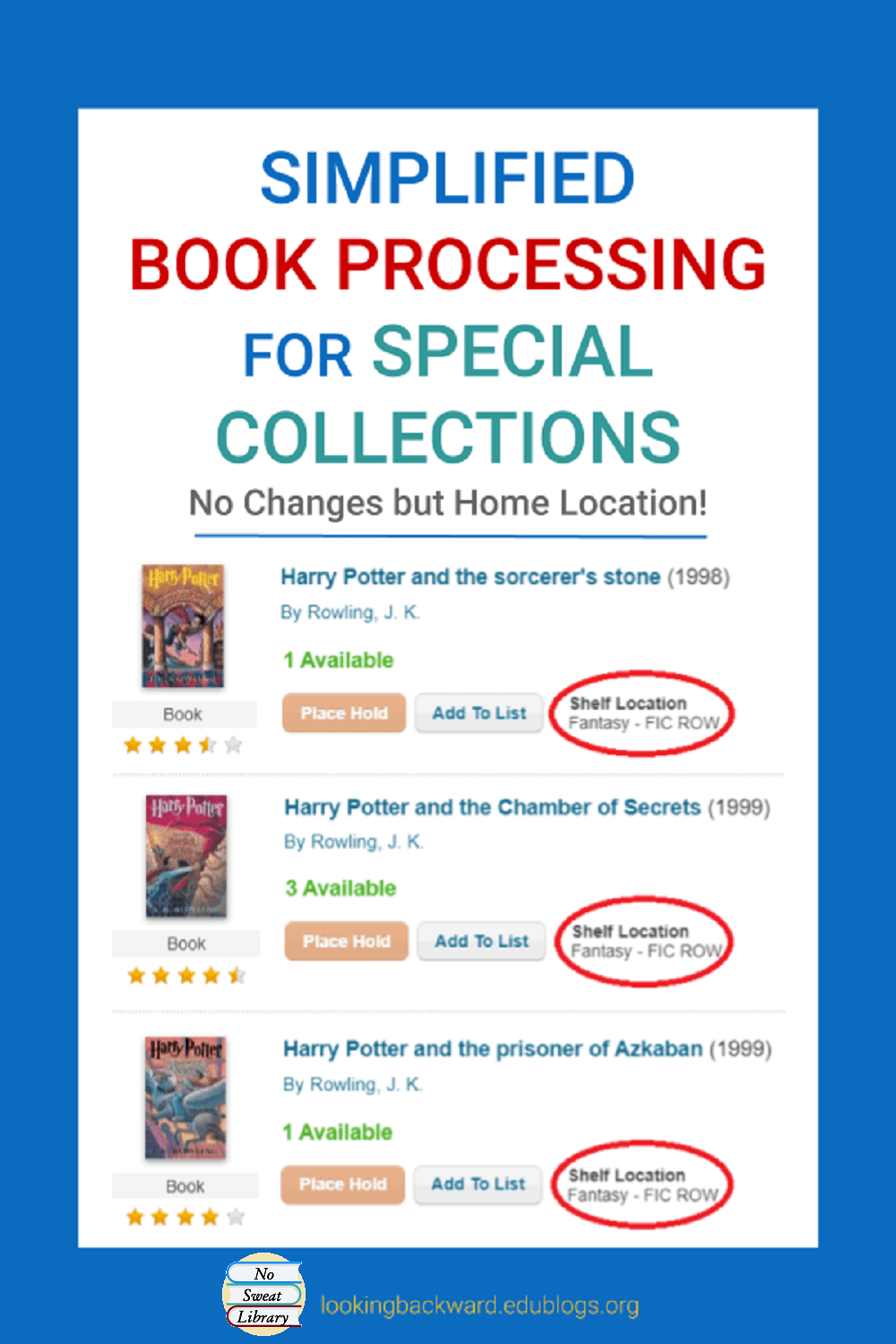
Before creating my first special collection I thoroughly planned how to do it: apply a Subject sticker under the spine label, a transparent color symbol or label protector over the Call Number spine label, change the Home Location in the automation system, and shelve the books together with colorful customized signs and shelf labels. This S-S-S Systemstickers, shelving, and signage—is simple and fast, and anyone can sort books for re-shelving with a quick glance at the sticker or color label … as in, “Judy, I need you to shelve all the ‘red’ label books.”

I’ve written about some of my Special Collections, but here’s a list of all 10 of them, in the approximate order I created them over the years:

  • Texas State Reading List collections – the middle school Lone Star books and selected high school Tayshas books.
  • Careers – books pulled from other Dewey sections and shelved together under the 331.7 Dewey books; they’re easy to locate for pleasure reading and for the Careers class project.
  • Multicultural Fiction – I decided not to separate these books from the rest of the fiction collection, so I applied stickers at the top of the spine. You could also add a tag in the MARC record so a Subject search for multicultural fiction would bring up the collection.
  • Graphic Novels—fiction and non-fiction plus Manga series.
  • Picture Books and Quick-Reads (easy-readers & books <100 pages) – I moved Picture Books, Quick-Reads, and Graphic Novels to adjacent shelves for ELL, SpEd and Read180 students to progressively build language and reading skills.
  • Quick-Bios (books <100 pages) for ELL, SpEd and RI, and Memoirs, a curriculum topic for 8g ELA.
  • Spanish Language Fiction and Spanish Language Dewey collections to support our IB language program. Spanish teachers schedule a Library Lesson for students to learn about, and check out books from, these collections.
  • Multicultural collections in 973.04 for Multicultural U.S. History (Civil Rights movement, etc.) and on the shelf right below, 973.08 for Multicultural America (.08 is for “kinds of people”).
  • Fiction Subjects: Adventure, Fantasy, Historical Fiction, Humor, Mystery, Realistic Fiction, Romance, Scary (Horror), Science Fiction, and Sports.
  • Special Social Studies Collections: GlobeTrekkers (fiction & Dewey sorted by continent), Totally Texas (Texas Fiction & 976.4), and Read America (Historical America fiction & 973)

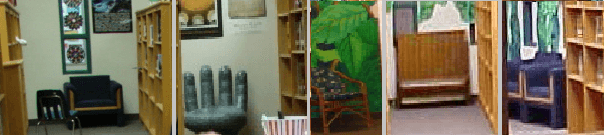
DEAR Time during ELA visits prompted me to add additional furniture and create special seating areas in the library. I now have a chair or bench at the end of each aisle so students can look over books. Students earn the privilege from their teacher to sit in a solitary chair to read by themselves or in the small group seating in the magazine area. I didn’t use library funds—I raided the district warehouse for discards, accepted donated chairs from parents, and donated a couple of my own. Even the theater teacher gave me seating items to clear out her props room, yet they are readily available when she needs to borrow them back for a performance!

Photo of special library seating at the end of certain aisles of books.

A few special seats

SIMPLIFIED COLLECTION DEVELOPMENT

Simplified Library Orientations and Special Collections makes collection development easier because I know exactly what to look for in catalogs and book reviews. The first expenditures from my book budget are for Special Collections, so I can keep them fresh and inviting to students. With vendors I create a separate book list for each Special Collection. I print out each collection list—so when books arrive I can quickly separate and label one group at a time—then combine them into the vendor order to clear the lists for future additions.

Special Collections simplify book ordering when you create individual collection booklists that you print out to simplify processing with my S-S-S System. Learn more here! | No Sweat LibraryMy district has a standard for book processing, cataloging, and spine label call numbers, so using only stickers and transparent labels to identify Special Collection books means NO changes to call numbers or spine labels. In my automation system I’ve added Special Collection names to the Home Location field—the one that shows when a book is on the shelf or checked out. I use the batch feature to set each name so I can scan all the new books in each collection at one time. An online catalog search displays the Home Location field so viewers know that a book is in a Special Collection location (or that it’s checked out). It’s also very easy to generate customized reports using that field:

  • Circulation statistics show which collections are most popular and need more books or which titles need additional copies.
  • Aged and low-circulation statistics allow me to quickly weed books throughout the year, one special collection at a time.

SIMPLIFIED LIBRARY PROMOTION

I’m not a bulletin board person. The 3 bulletin boards outside the library near each grade-level hallway were decorated at the start of school and left until the end of the school year. After customizing Library Orientations, I was inspired to create a bulletin board specific to each grade level that changes every grading period to coordinate with classroom activities and to promote reading and the library. Each board has signs for:

  • ELA grade-level theme that changes with each GP unit, and pictures of books related to that theme.
  • Social Studies grade-level theme, along with pictures of books to coordinate with classroom content. Each board has a pocket with grade-level Social Studies bookmarks so students can grab one if they need it.
  • Subject area library visits scheduled for the grading period, along with Dewey-book pictures and infographics of online services for any research projects that will bring subject area classes to the library.

When students talk about a good book, I have them create a book review on a 3”x5” card and staple it on the board. It’s a great way to involve students and to update bulletin boards without a lot of extra work.

Learn more about Purposeful Library Bulletin Boards by joining my Mailing List and downloading the FREE ebook with signs you can use!

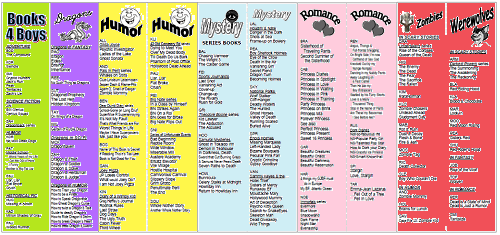
Snip of several colorful topical bookmarks side-by-side

Examples of topical bookmarks

Changing the focus of orientations to reading also prompted me to create my own customized Reading Records and Series & Topical Fiction bookmarks. Using letter-size color card-stock I can create 6 bookmarks with lists of books on both sides. From a ream of card-stock I get ~3000 bookmarks for the same price as 500 from library suppliers. I also customize bookmarks for Lexiled reading lists for ELL/SpEd/Read180 classes and for research project print & online resource lists.

SIMPLIFIED PROFESSIONAL DEVELOPMENT

I’ve written before about my science and social studies background, which helps for choosing non-fiction books and coordinating content-area reading into lessons. Even for my own reading I prefer non-fiction (except mysteries). Consequently, following orientation changes, my professional development became more focused on ELA standards, on reading levels for students and books, and on middle school fiction. I read professional books, attend workshops, and indulge in librarian blogs featuring fiction books and promoting independent reading. I’m also more attentive to book reviews and recommendations from other librarians in my district and on the listservs. I’m still not as adept as someone from an ELA background, but every step forward improves student use of our library, the circulation of books, and my ability to help students find a perfect book to read.

Logo for No Sweat Library on Teachers Pay Teachers
I have many products for facility management and library lessons in No Sweat Library, my TPT store. You’ll especially like my Library Orientations, customized for each grade, 6-8.

line of books laying down - indicates end of blog articleUpdated 2026.

Join my mailing list to get a brief email about new posts on library lessons & management. You'll also gain access to my exclusive e-Group Library of FREE downloadable resources!